Author David Wilkinson
After decades of impactful careers, artists often feel the need to do something to explain themselves. Their publics kind of liked their stuff, but did they really understand? Or did the time not quite get it? And as times change, as the sands shift, positions must somehow be located. Whether Paldrok intends it or not, this exhibition has a bit of that feeling about it. And for anyone with even the slightest inclination to resolve the mystery that is Paldrok, attendance is necessary.
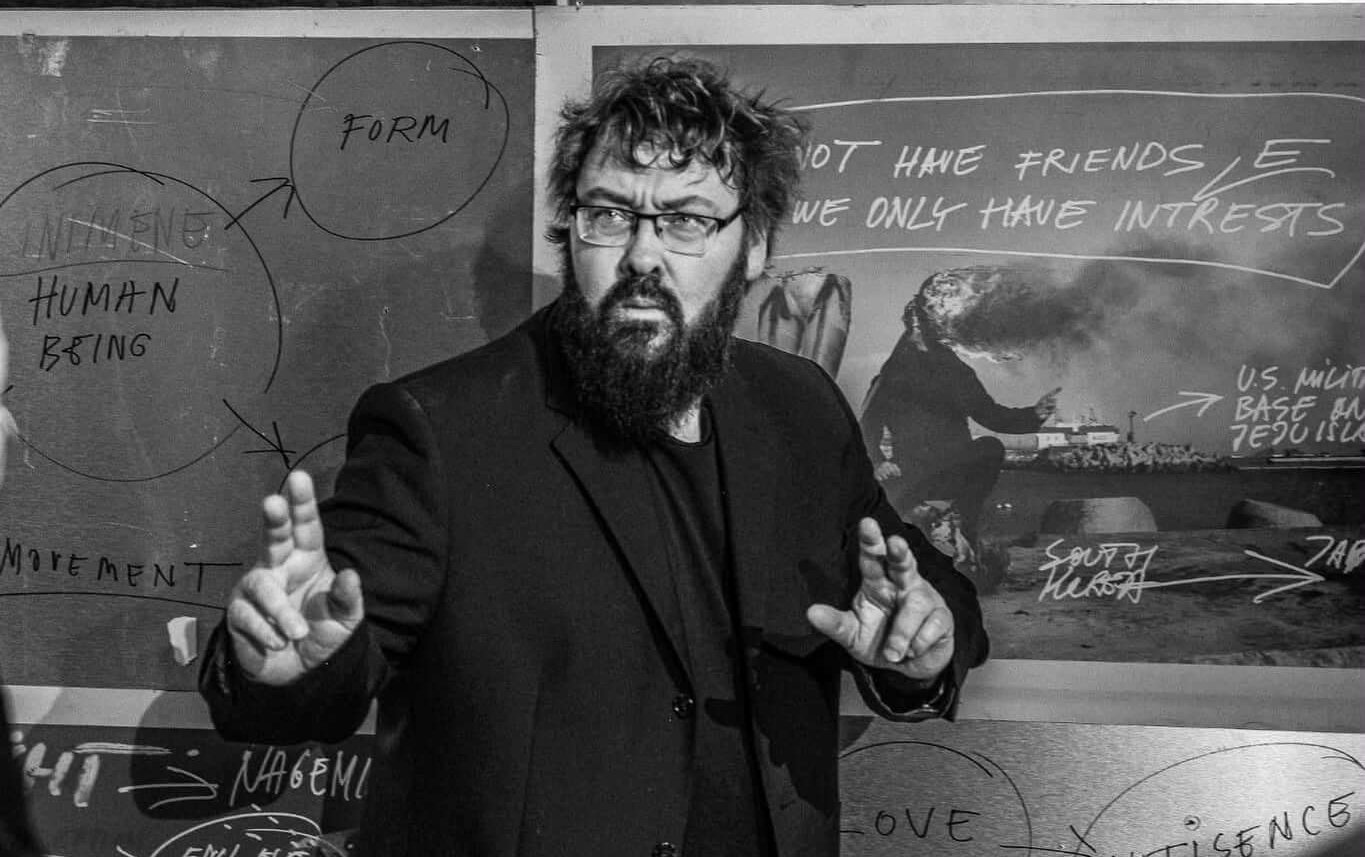
You see, there is a lot of text on the walls. It is not quite a sudden thing. I remember at the opening of an exhibition in the Hipster Quarter in Tallinn a couple of years ago, he joked that for those who had complained that they could not understand his pictures, these ones had words written on them so that now no one had an excuse not to understand. Of course, only a few probably did. No matter, understanding is not always necessary. But art must have intention. Of what people heard of what he said at the opening, “interaction” was a major theme. That word is often squandered in the art world. It often means no more than some conceptual lump where you can push a button or twiddle a knob. Here is my art, and you can interact with it if you like. Paldrok seems to start from an intention to interact with the viewer, even on the viewer’s terms. The interaction starts with the artist listening. This is art as giving.
If the job of the artist is to give, it is not to go around giving out sweets and cakes. So it is that what is given needs to be explained and at least a little bit understood. There is a story in Luke’s Gospel (Luke 11): a Pharisee invites Jesus home for lunch. You might think that the Pharisee was in for a spiritual pat on the head, but a squabble breaks out. The Pharisee reprimands Jesus for not observing the traditional hygiene ritual; Jesus tells him that it is more important for a man, like a cup, to be clean on the inside as well as on the outside, that the Pharisee was very good at public demonstrations of giving to the poor from the purse, but you must also give of the spirit. What does it mean to give of the spirit?
I am not claiming Paldrok as a Christian artist, but when Jesus asks about giving of the spirit, the artist at least needs to know what he is talking about. An artist has to know what he means—well, an artist of the Paldrok school needs to know what it means. Well, what is it to give as an artist? What does Paldrok mean by it?
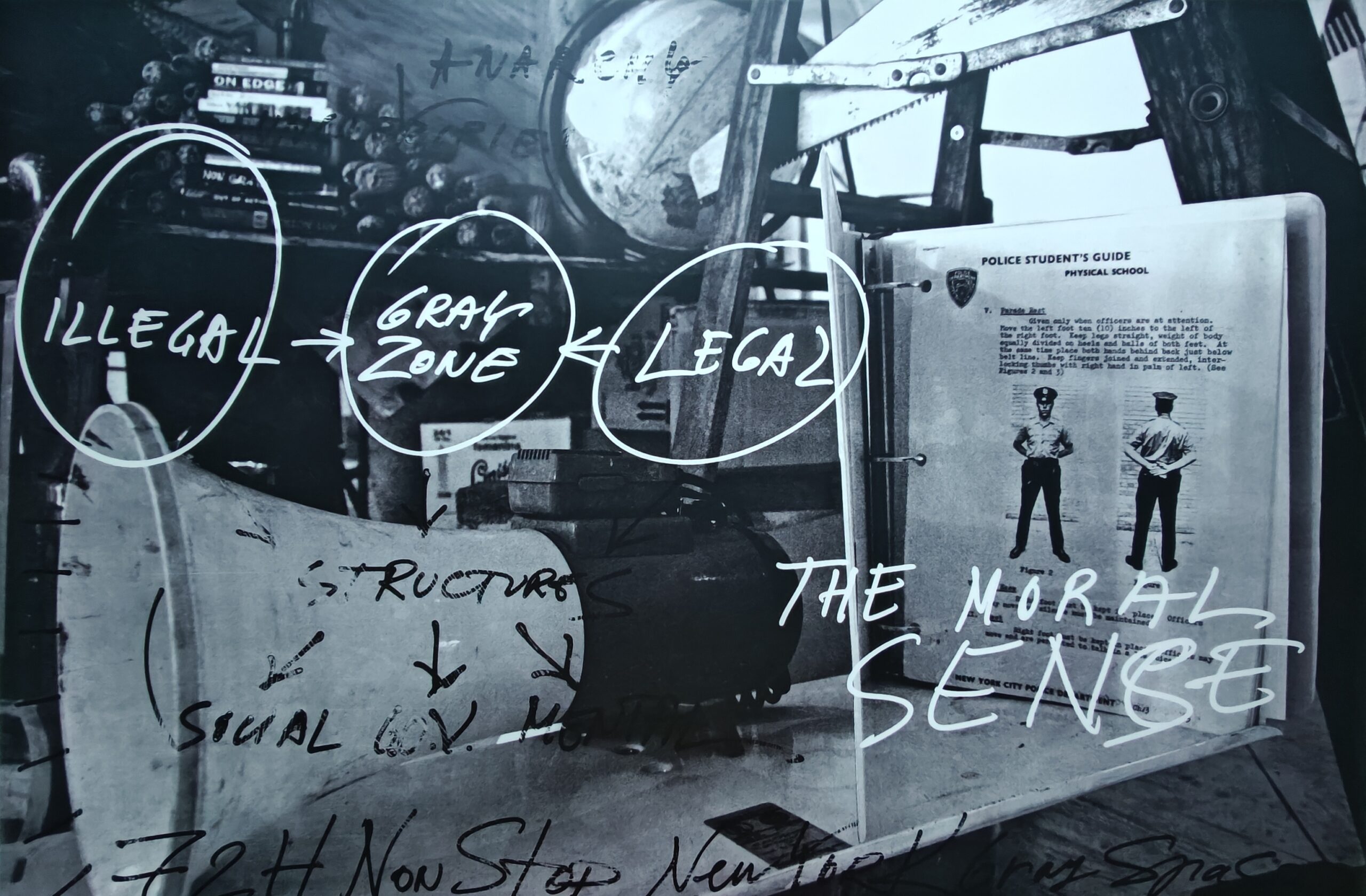
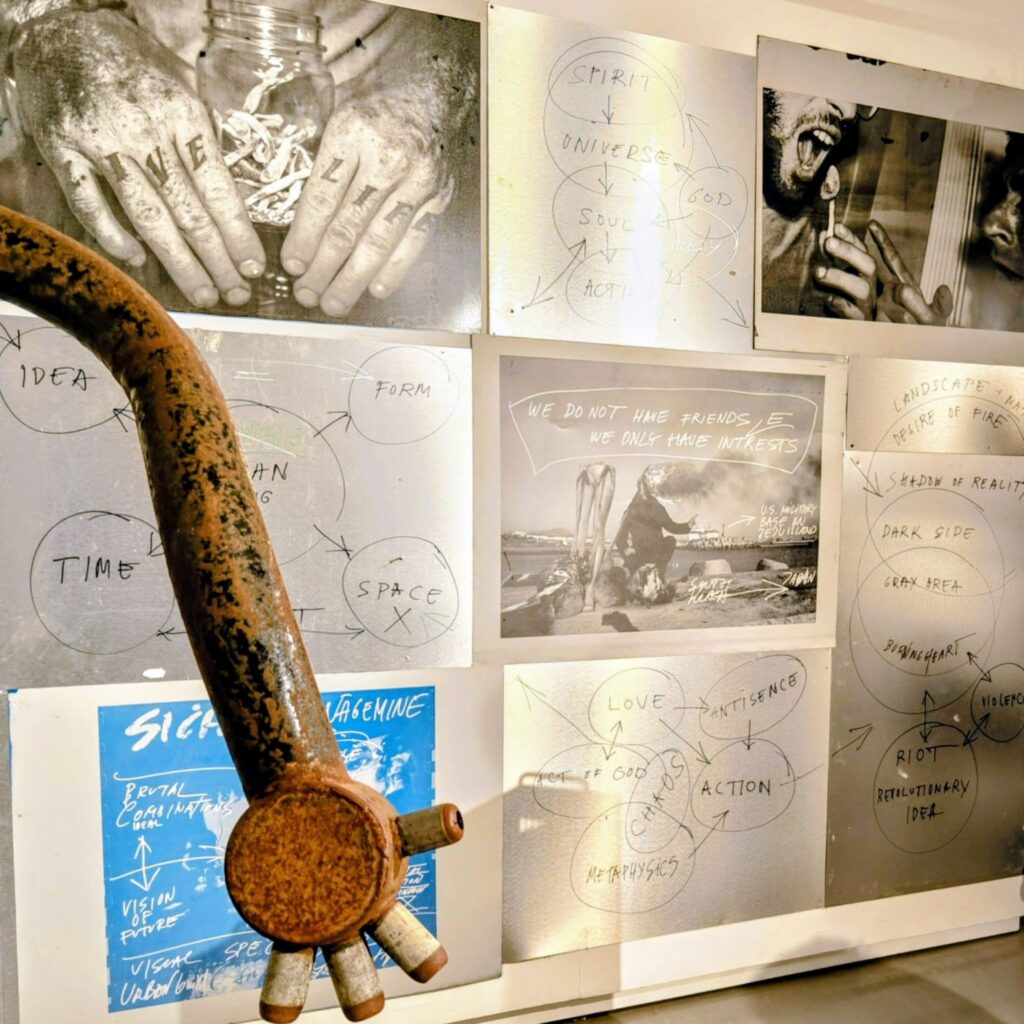
The flow of ideas is depicted by Venn diagrams. Are these the project plans for a performance or notes for an interpretation? Wisdom, Faith, Madness overlap in a Venn diagram. Mental and physical madness. Health, sex, education, empathy, open mind, power, knowledge, genes all feed in. The background is built of the social, political, anthropological, historical, cultural, virtual, material, mental, and geographical. That is what you might feel this exhibition is starting to explain.
“The Temporal Dimension of Existential Space” exhibition might not quite explain, but it will give an insight into the man talking quietly and not through his feathered megaphone. The words are in frames like pictures. From a distance, they look like they might be sonnets, big squares of words. On closer view, there is too much to be sonnets, too many lines, too many words. Reading from the first word doesn’t work so well; the clauses are not presented in order like an article or essay or even a sentence, rather more like a list. A list of something. There is too much, and people quickly realised that the only thing to do was to photograph them on mobile telephones and try to read them at home.
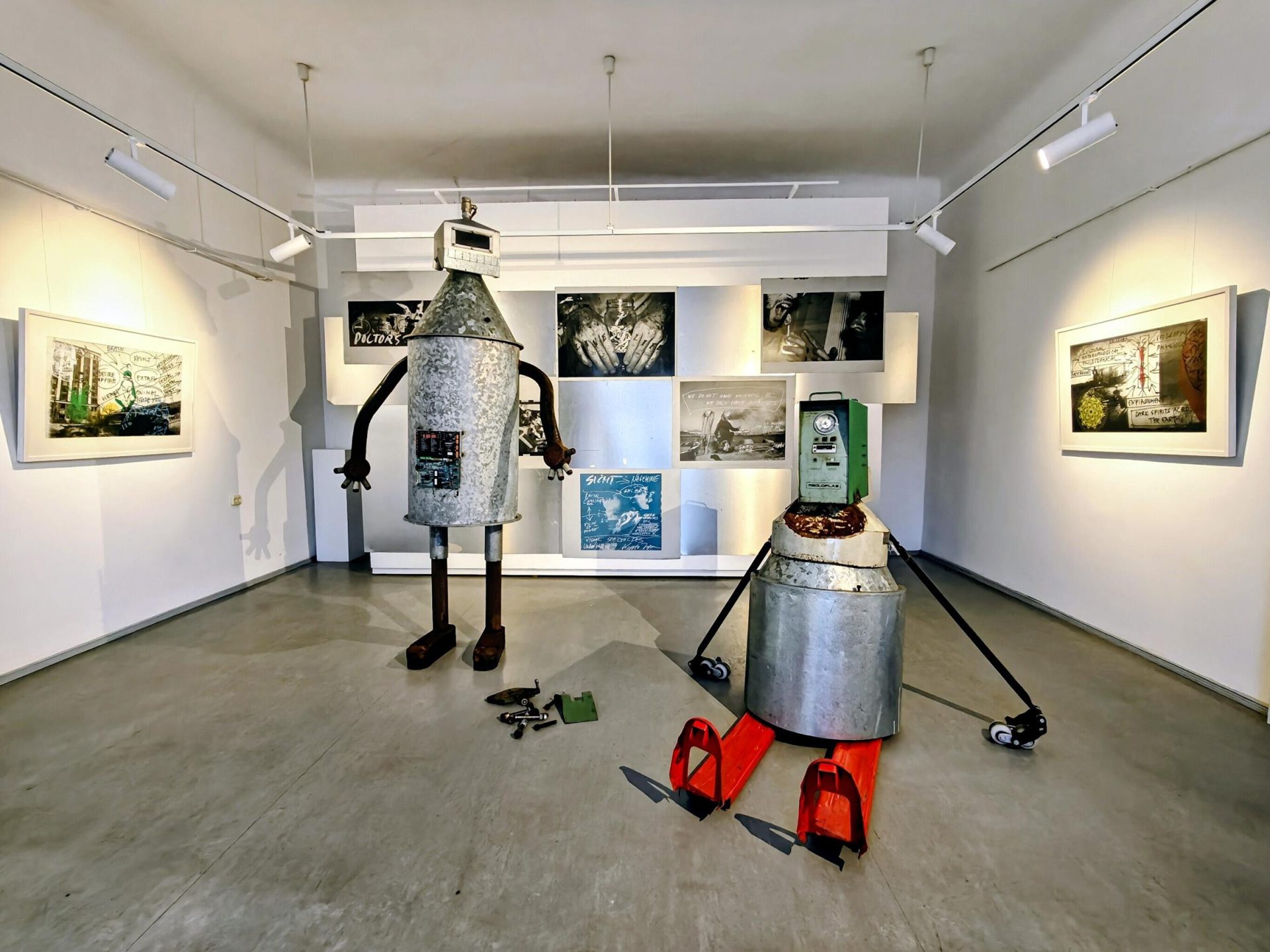
There are new works: robots. Sculpture is the senior art form. These robots are visually very different from his recent “Momentum / Monumentum”. A hundred years ago, modernity, modern technology, was largely seen optimistically. Well, maybe more optimistically in the British, American, and French Art Deco ocean liner, the railway locomotive, the motor car, and the aeroplane than in German Expressionism. But still in contrast to today’s feelings.
Today also we have new technology, but it provokes anxiety—the fear of AI fooling us and deceiving us. They say that an iPhone has more computing power than all of NASA when they pretended to send men to the moon in the 1960s. We fear modern technology as a tool of surveillance and fear AI robots replacing all workers. We are so afraid of social media that there are rapid moves to ban it for everyone until they are 16. Is this fear the same old junk in a new arrangement?
Paldrok’s robots are made of old junk found in the yard of his Loovlinnak. The robots look somehow like 1950s robots. Like those toy Japanese robots that somehow represent the early Cold War I. Is this Cold War II, where things are reversed, the defining fear of the summer? Is this the moment that demands we explain ourselves? Maybe Paldrok is not explaining himself in this exhibition but explaining the moment, explaining us. Is Paldrok explaining himself or pinning himself in time? Are they different? I still don’t understand.
“The Temporal Dimension of Existential Space”
Al Paldrok
06.02.2026 — 07.03.2026
Kastellaani Gallery, Tallinn